obsidian-vault-methodology-template
Obsidian + Claude Code vault methodology — agents, slash commands, wiki architecture. CC BY-NC 4.0.
Persistent Memory for AI Agents — an Obsidian Methodology
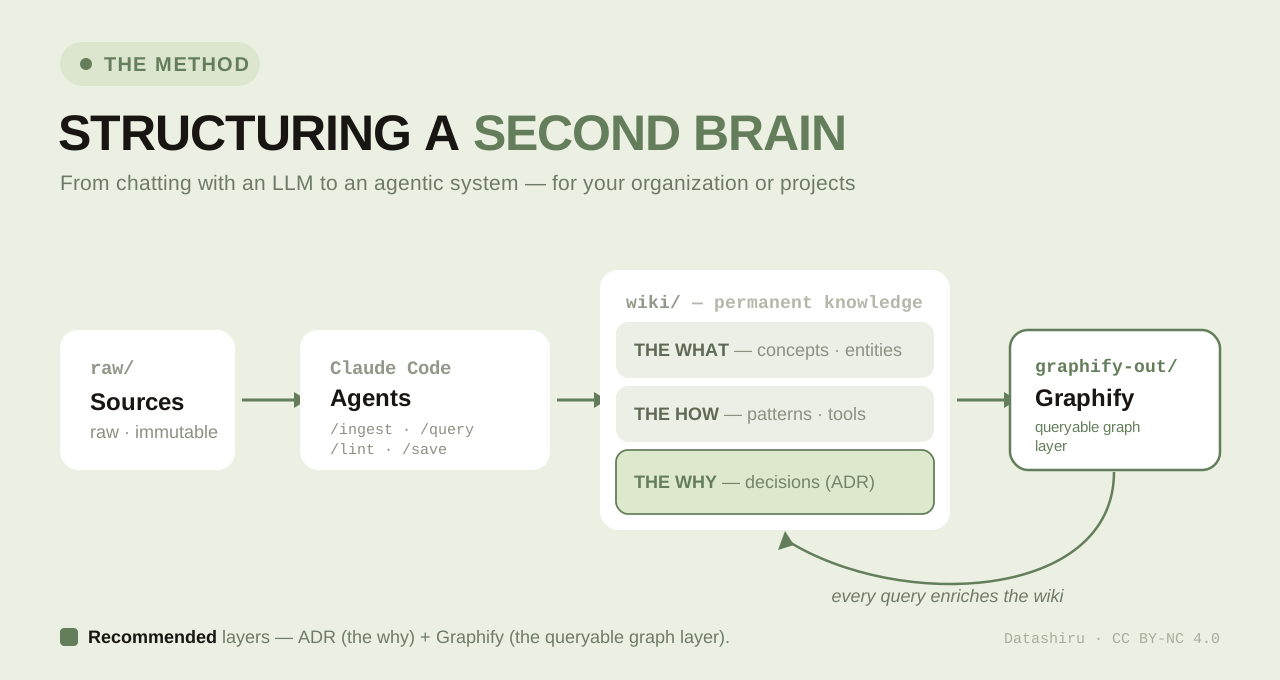
Structuring a second brain: going from chatting with an LLM to an agentic system for your organization or projects.
A structured methodology for building a persistent knowledge base in Obsidian, powered by Claude Code agents, with two recommended layers — Graphify (a queryable knowledge graph) and ADR (a decision log). Inspired by Andrej Karpathy's work on LLM memory.
The core idea: instead of using AI to answer questions from scratch each time, you compile knowledge permanently into a wiki. Each conversation enriches the base — nothing disappears into chat history.
Author: Nicolas / Datashiru — licensed under CC BY-NC 4.0.
The three pillars
1. Obsidian — the wiki, your IDE
Obsidian isn't just a note editor: it's where the knowledge lives. Every wiki page follows a fixed structure (frontmatter, TL;DR, limits and counter-examples, relations), and [[wikilinks]] weave the explicit graph between notes. Obsidian stays the tool for human navigation and editing.
2. Claude Code — the agent that compiles the knowledge
Claude Code plays the programmer: the wiki is its codebase (Markdown), Obsidian its IDE. Four commands structure the knowledge lifecycle:
/ingest— turns a raw source (raw/) into structured wiki pages/query— answers from the wiki, not from the model's general knowledge/lint— checks vault health (orphans, duplicates, broken links, stale content)/save— crystallizes a session answer into a permanent wiki page
Each command delegates to an isolated sub-agent that receives only the context its task needs (roughly 40% fewer tokens than a single agent loading the whole vault — an order of magnitude, not a rigorous measurement). The commands and sub-agents ship ready to install in templates/claude-code/.
3. Graphify — the queryable knowledge graph (recommended)
Past a certain volume, re-reading the whole wiki for every question gets slow and expensive. Graphify indexes the vault into a graph (graphify-out/graph.json): nodes, explicit and inferred relations, detected communities.
The "Read Graph" skill — documented in an AGENTS.md at the root, readable by any agent, not just Claude Code — enforces a 3-step protocol: consult the graph first, identify the relevant files, then selectively read full content only when necessary. This cuts token consumption compared to reading every file directly.
This layer also enables consistent multi-agent access: several agents (local Claude Code, an agent on a VPS, etc.) can consult the same graph and answer from the same structure, via read-only Git sync rather than exposing the vault on the network.
The mechanism that keeps the decision layer alive
An ADR isn't written "on top of" the work: it graduates from the daily note. A decision noted in daily/ is ephemeral by construction — retention is 30 days. If it's structuring and durable, it moves to wiki/decisions/ before the purge, and becomes queryable through the graph.
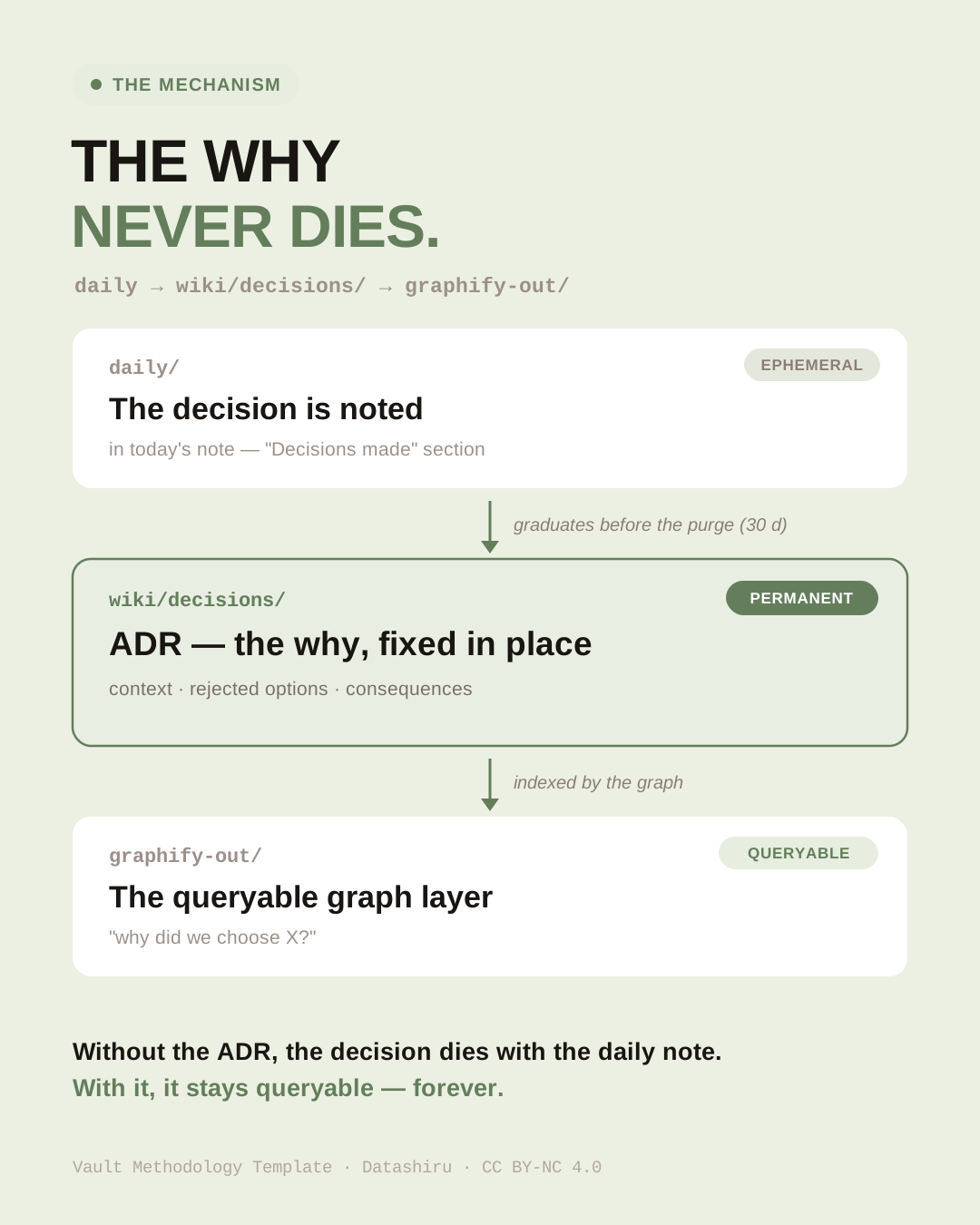
Without that graduation reflex, the decision layer is dead: decisions stay in daily/ and vanish with it.
What's inside
- Architecture — a layered folder structure (
raw/,wiki/,context/,daily/,projects/) - 4 core slash commands —
/ingest,/query,/lint,/save— plus/adr(decisions layer) and/init-vault(bootstrap) - 3 specialized agents — each agent receives only the context it needs
- Wiki page structure — frontmatter, TL;DR, limits & counter-examples, relations
- Decision layer (ADR) — recommended: captures the why behind choices (context, rejected options, consequences), with an
/adrcommand - Naming conventions — closed tag lists, kebab-case, ISO date prefixes
- Initialization checklist — step-by-step from zero to first ingestion
- Split vault rules — when to create a new vault (thematic threshold + 500-page review ceiling)
- Knowledge graph layer (recommended) — Graphify integration + "Read Graph" skill for token-efficient, multi-agent queryable access, with a ready-to-copy
AGENTS.mdskeleton (templates/AGENTS-vault.en.md) - Ready-to-install agent kit — the 6 slash commands, the 3 sub-agents and the skeletons
/init-vaultinstantiates, in French and English (templates/)
How to use
Prerequisites: Obsidian, and Claude Code already installed and familiar. The method assumes you can start a session and invoke a slash command — it doesn't teach that.
- Copy
vault-methodology-template.en.mdinto your Obsidian vault root (orvault-methodology-template.mdfor the French original) - Install the agent kit — commands, sub-agents and skeletons — into the vault's
.claude/:cp -r templates/claude-code/en/. /path/to/your-vault/.claude/ mkdir -p /path/to/your-vault/.claude/templates cp -r templates/context templates/CLAUDE-vault.en.md templates/adr-template.en.md /path/to/your-vault/.claude/templates/ - Run
/init-vault <domain>— it lays downcontext/ligne-rouge.md(your "Red Line") and stops. Write your non-negotiable constraint for this vault, then run it again - Follow the initialization checklist at the bottom of the template
- Adapt the domain examples to your field
- (Recommended) Enable the ADR then Graphify layers once the core loop is second nature — see "Step 5" and the dedicated sections in
vault-methodology-template.en.md
The template is intentionally domain-agnostic. Adapt it to your field.
Philosophy
Source → Ingest → Wiki → Query → Synthesize → Wiki (enriched)
Knowledge compounds. A vault used for 6 months becomes exponentially more useful than one used for 6 days — because every query builds on prior ingestion.
License
CC BY-NC 4.0 — free to use and adapt, attribution required, commercial use prohibited.
How to Install
- Download the ZIP or clone the repository
- Open the folder as a vault in Obsidian (File → Open Vault)
- Obsidian will prompt you to install required plugins
Stats
Stars
2
Forks
1
License
NOASSERTION
Last updated 1mo ago
Categories
Tags