Obsidian has taken over my life
2026-05-22T00:00:00
I was gonna make this first real blog post about Obsidian on the web, because I got obsessed with making Obsidian work in a browser like a normal person. But then I went too deep into it and this blog is days late so I'm gonna yap about what makes Obsidian so special imo.
My vault has slowly become this extremely personal operating system. I don't mean it in the productivity-YouTuber way where every note has seventeen properties and a quarterly review ritual, I mean it literally. Stuff from the rest of my life keeps getting pulled into Obsidian until the vault is the place where I can actually do something with it.
LeetCode problems, school PDFs, Kavita reading, handwritten math, emails, GitHub issues, pull requests, job applications, random ideas, class notes, dashboards all of it. It's not polished, it's not minimal, and it's not something I'd hand to a normal person and say "copy this exactly." But it's the kind of Obsidian setup that only Obsidian could really become.
That's what I want to yap about.
Obsidian's file first approach
A lot of apps have a strong opinion about what belongs inside them. Email apps want email, task apps want tasks, reading apps want books, school portals want suffering.
Obsidian is different because at the end of the day it's just files. Markdown, attachments, folders, links, frontmatter, plugins, and whatever cursed automation I decide to point at it that week.
That means a note can be:
- a lecture summary
- a job application tracker
- a LeetCode problem
- an email I need to respond to
- a GitHub issue
- a handwritten statistics practice sheet
- a chapter from something I'm reading
- a dashboard that tells an agent what I should care about today
- don't forget canvas, bases, and the view types added by the many many plug-ins
And the app doesn't freak out. It just indexes the files and lets the ecosystem do the rest.
Sounds simple but it's the whole trick.
My email lands in Obsidian now
One of the most useful automations I have is an n8n workflow that turns incoming email into Obsidian notes. It polls Gmail every minute for unread mail, normalizes the message, converts the HTML body to Markdown, drafts a suggested response with an LLM, builds a note, and commits it into my vault through GitHub.
The note ends up in Articles/mail/ with frontmatter like:
- who it came from
- who it was sent to
- the subject
- the date
- whether it came directly from Gmail or was forwarded from Outlook
- message and thread IDs
- status set to unread
- tags for email/source
Then the body is split into two sections:
## Email

[the email converted to markdown]

## Suggested Response

[a ready-to-edit draft reply]
This matters because my inbox stops being this separate guilt box. If something's important enough to respond to, it can become part of the same system as everything else. It can be linked to an application, a class, a project, or a task. If a recruiter emails me, that email lives next to the company note and the cover letter. If school mail gets forwarded in, the workflow tries to pull the original sender out of the forwarded header instead of pretending everything came from myself.
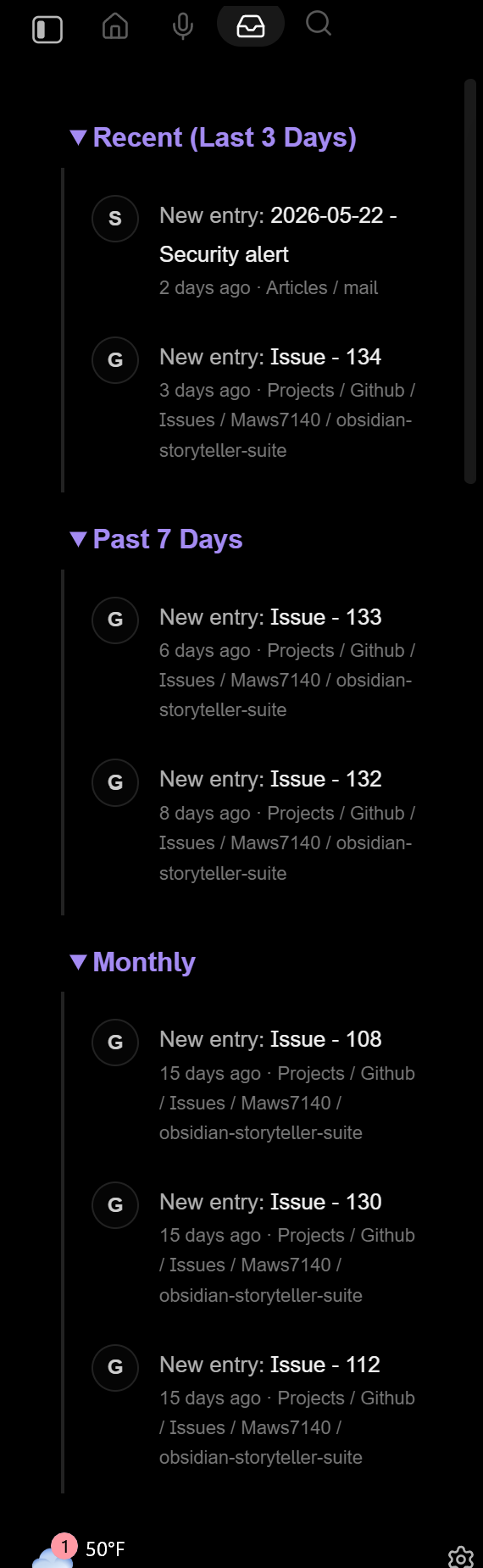
Inbox dashboard.
GitHub issues and PRs belong in the vault too
The GitHub side follows the same idea. If email can become notes, GitHub work can too.
Issues and PRs are already structured writing. Titles, bodies, comments, statuses, links, branches, reviewers, decisions that's basically Obsidian material begging to be connected to the rest of the vault.
For me this matters because I'm building things around Obsidian itself, like Vault Hub and Storyteller Suite. A GitHub issue isn't just a GitHub issue. It might be connected to:
- a plugin feature idea
- a bug I found while using my own vault
- a blog post I want to write
- a CSS snippet or template that should exist on Vault Hub
- a task note that tells me what to fix next
GitHub is where the code conversation happens, but Obsidian is where the bigger context lives. Pulling the important parts into the vault means I can see the work next to the why.
And if an agent can read my notes, tasks, project files, and GitHub context, then "fix this PR" isn't floating in space anymore. It has memory, links, and the project's messy context.
LeetCode as vault material, not just a website streak
LeetCode is another one of those things that normally gets trapped in its own platform. You solve the problem, maybe you look at the editorial, maybe you forget it three days later because all the learning stayed inside the website.
I want those problems in Obsidian because I want them to become part of my actual study system.
A LeetCode note can hold:
- the problem statement
- my first wrong idea
- the final solution
- patterns like sliding window, binary search, dynamic programming, graph traversal
- what I should recognize next time
- links to similar problems
- reminders to retry it later
That's way more useful than just knowing I did "some array problem" last Tuesday. Once it's in the vault, it connects to data structures notes, interview prep, job applications, or whatever skill gap I'm trying to close.
I'm not trying to hoard solved problems I want a memory of how I think through them.
Kavita makes reading part of the same universe
Kavita's great as a self-hosted reading server, but the thing I actually want long-term isn't just "I can read books/comics/manga from my server." I want my reading to leave useful residue.
If I read something and it sparks an idea, I don't want that idea trapped in a reading app. I want it in Obsidian where it can become a note, a quote, a project idea, a blog draft, or a reference for something I'm building.
Sometimes the source is a textbook, sometimes it's documentation, sometimes it's a manga panel that makes me think about storytelling structure, sometimes it's a random chapter that gives me a UI idea. The vault doesn't care. If it matters, it can go in.
The handwriting setup is probably the most underrated part
The handwriting side is one of my favorite parts because it solves a problem most note apps handle badly: math and diagrams.
Typed notes are great until you're doing probability, linear algebra, stats homework, or anything where the fastest way to think is to just write. I don't want to choose between "pretty typed notes" and "actual scratch work." I want both.
So my vault has handwritten work living alongside normal Markdown. Excalidraw and attachment notes let me keep handwritten practice, diagrams, and worked problems in the same knowledge base as the lecture notes. My stats practice isn't some separate pile of screenshots it's part of the course folder ecosystem. It can be linked, searched around, embedded, revisited, and used as evidence of what I was struggling with.
This is especially huge for school. A normal notes app might let you draw, a PDF app might let you annotate, a whiteboard app might feel nice but Obsidian lets the handwritten work sit next to the structured notes, tasks, dashboards, and agent context.
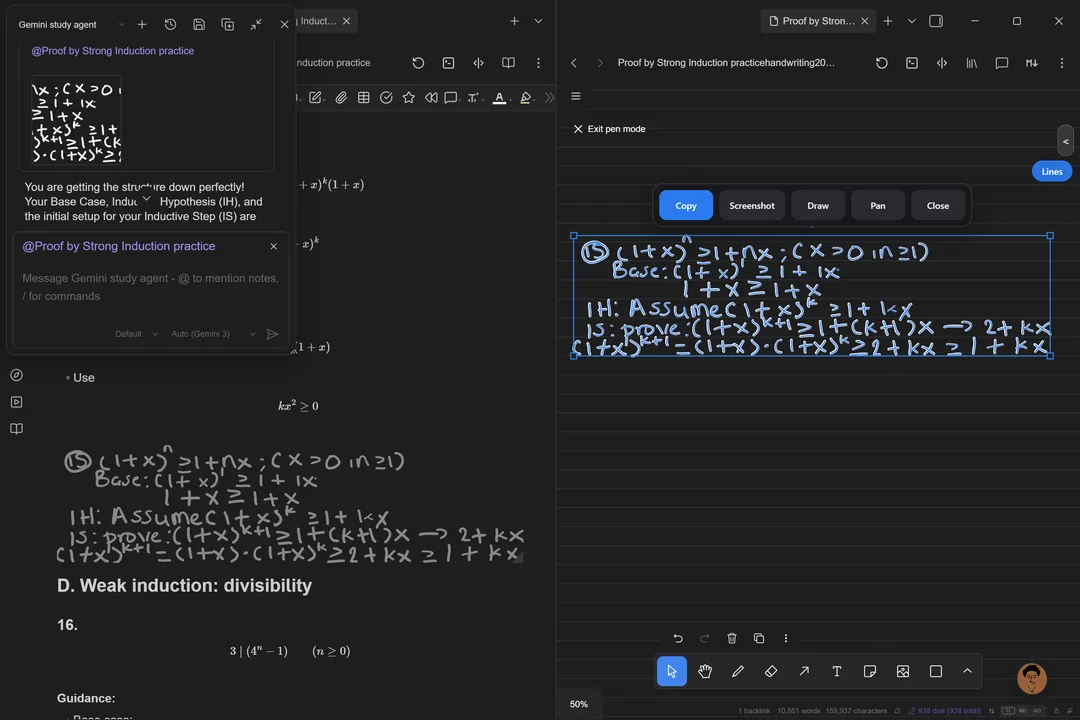
Handwritten workflow.
The vault is also my job hunt machine
This setup accidentally became really useful for job applications too.
Company pages, cover letters, application notes, recruiter emails, automation scripts, follow-up tasks they all live under the same umbrella. An incoming email becomes a note. A cover letter links back to the company. A follow-up becomes a task. If I automate part of the application process, the script and the notes sit near each other.
This is the kind of workflow where Obsidian's files-first thing gets extremely practical. I'm not waiting for one app to support every tiny thing I want I can glue the pieces together myself.
And yes, sometimes the glue is messy and leaves my fingers all sticky. Messy and mine beats clean and trapped.
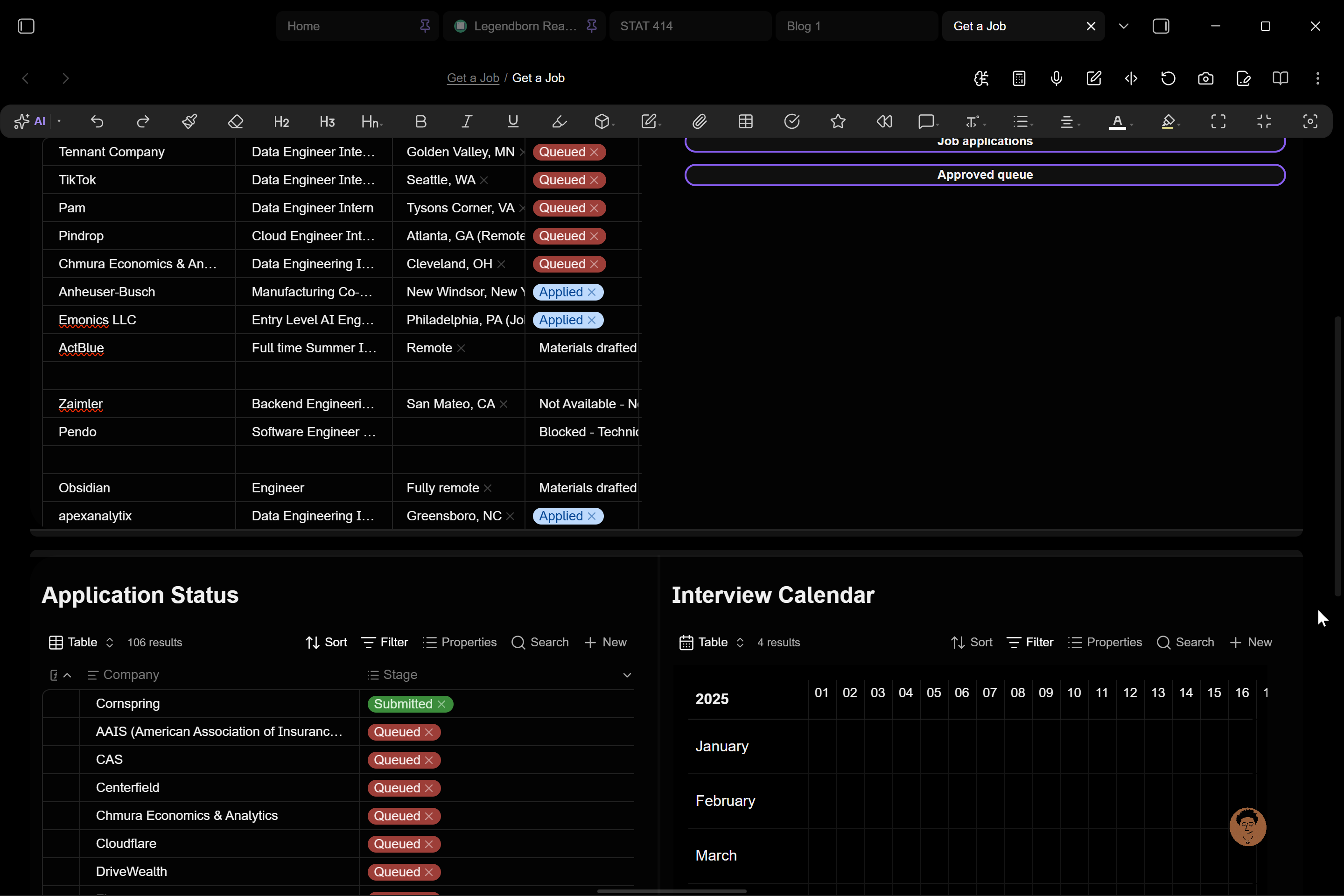
Job board.
Dashboards are how I actually use any of this
None of the above matters if I can't see it. With notes coming in from email, GitHub, LeetCode, Kavita, school, and whatever else, the vault would just be a pile if I had to dig through folders every time I wanted to know what's going on.
That's where dashboards come in. Mostly Bases and Dataview, sometimes a Canvas, sometimes a hand-built note with embedded queries. The point is always the same: pull the right slice of the vault into one view for whatever I'm trying to do.
A dashboard isn't a fancy UI, it's just a note with queries that asks the vault questions. But because everything else in my life is already vault material, the dashboard can actually answer them. And the same dashboard doubles as agent context, if an agent reads the "Today" note, it knows what I should care about without me having to re-explain my entire life.
What makes obsidian a shining gem
There are apps with better databases, better task management, better drawing, better email, better AI, better collaboration. The reason I keep coming back to Obsidian is that it lets me combine things that were never supposed to be combined.
My vault can be a school notebook, a blog CMS, a coding journal, a reading log, an email triage system, a GitHub context layer, a handwriting archive, and an agent workspace without asking permission from a company roadmap.
I don't want a perfectly clean vault. A perfectly clean vault would probably be less useful. Mine's useful because it reflects the actual chaos of what I'm doing.
There is always more work to be done
I don't think this vault will ever be finished. Every time I solve one friction point, I notice another.
Email becomes notes. Okay, now those notes should become tasks when they need action. LeetCode comes into the vault. Okay, now solved problems should resurface before interviews. Handwriting lives with class notes. Okay, now agents should be able to figure out which handwritten practice belongs to which exam.
Thanks for reading. This was less about making Obsidian pretty or minimal and more like: here's what happens when you treat Obsidian as a programmable home base for your digital life. It gets weird, it gets powerful, and if you're the kind of person who sees a Markdown folder and thinks "what if my entire life could POST to this" Obsidian is still unmatched.